New York Quitclaim Deed Form
When it comes to transferring property in New York, the Quitclaim Deed form plays a vital role. This simple yet effective document allows one party, the grantor, to transfer their interest in a property to another party, the grantee, without making any guarantees about the title. The Quitclaim Deed is particularly useful in situations such as transferring property between family members, clearing up title issues, or during divorce settlements. It is important to note that this form does not ensure that the property is free of liens or other claims; it merely conveys whatever interest the grantor has. Completing the form requires basic information, including the names of both parties, a description of the property, and the signature of the grantor. Once executed, the deed must be filed with the county clerk’s office to make the transfer official. Understanding the Quitclaim Deed can help individuals navigate property transfers smoothly, ensuring that all parties involved are clear on the terms of the transfer.
Preview - New York Quitclaim Deed Form
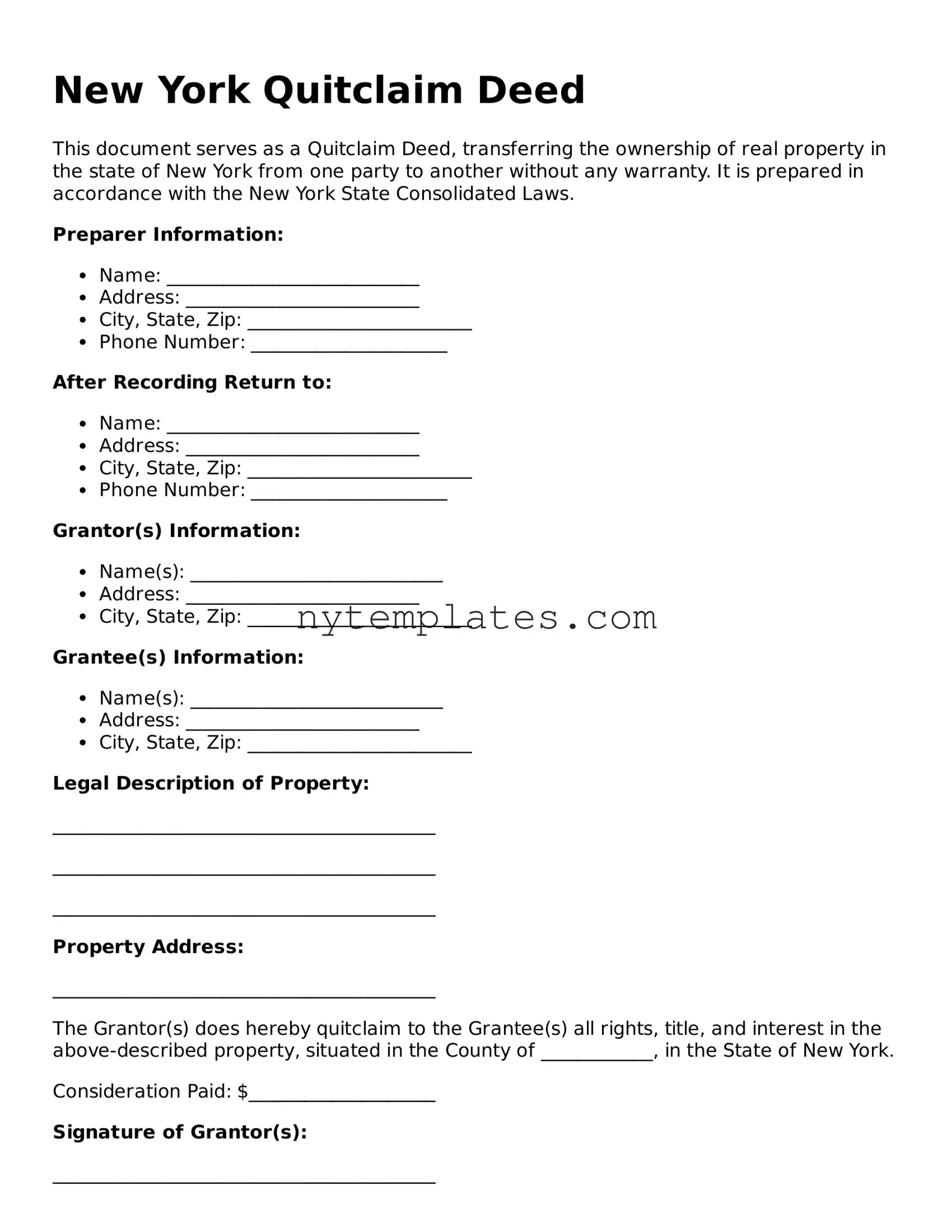
New York Quitclaim Deed
This document serves as a Quitclaim Deed, transferring the ownership of real property in the state of New York from one party to another without any warranty. It is prepared in accordance with the New York State Consolidated Laws.
Preparer Information:
- Name: ___________________________
- Address: _________________________
- City, State, Zip: ________________________
- Phone Number: _____________________
After Recording Return to:
- Name: ___________________________
- Address: _________________________
- City, State, Zip: ________________________
- Phone Number: _____________________
Grantor(s) Information:
- Name(s): ___________________________
- Address: _________________________
- City, State, Zip: ________________________
Grantee(s) Information:
- Name(s): ___________________________
- Address: _________________________
- City, State, Zip: ________________________
Legal Description of Property:
_________________________________________
_________________________________________
_________________________________________
Property Address:
_________________________________________
The Grantor(s) does hereby quitclaim to the Grantee(s) all rights, title, and interest in the above-described property, situated in the County of ____________, in the State of New York.
Consideration Paid: $____________________
Signature of Grantor(s):
_________________________________________
Date: ____________
Signature of Grantee(s):
_________________________________________
Date: ____________
This document was prepared by _______________ (name of preparer) on ____________ (date). It is recommended to consult with a legal professional before finalizing a Quitclaim Deed to ensure accuracy and legality.
State of New York )
County of __________ )
On this day, ____________, before me, _______________ (name of notary), personally appeared ________________ (names of individuals signing), known to me (or satisfactorily proven) to be the person(s) whose name(s) is/are subscribed to the within instrument and acknowledged that they executed the same for the purposes therein contained.
In witness whereof, I hereunto set my hand and official seal.
Notary Public: _________________________
My Commission Expires: ________________
PDF Specifications
| Fact Name | Details |
|---|---|
| Definition | A Quitclaim Deed is a legal document that transfers ownership of property from one person to another without any warranties. |
| Use | This form is commonly used among family members or in situations where the grantor does not wish to guarantee the title. |
| Governing Law | The New York Quitclaim Deed is governed by New York Real Property Law, specifically Article 9. |
| Filing Requirements | To be valid, the deed must be signed by the grantor and acknowledged before a notary public. |
| Tax Implications | While no transfer tax is typically due on a quitclaim deed, it’s important to check local regulations for any specific requirements. |
More New York Forms
New York State Employee Handbook Requirements - Details procedures for resignations and terminations, ensuring a clear process for transitioning employees.
Financial and Medical Power of Attorney Forms - Regularly reviewing and updating the General Power of Attorney ensures it reflects the current wishes and circumstances of the principal.